
The True Cost of Disconnected Systems at an Equipment Dealership

Ask a dealer principal what their service software costs and you'll get a number. Ask what the disconnected systems at their equipment dealership cost last year, and you'll get a pause.
That pause is the problem. You know something isn't working. Your parts counter retypes what service already entered, your accountant fixes invoices at month-end, and nobody trusts the inventory count. You just haven't put a dollar figure on it. This post helps you build one, rough but honest, in about an hour.
The Hidden Cost of "Good Enough" Disconnected Systems
Nobody decides to run five disconnected tools. It happens one sensible purchase at a time: QuickBooks for the books, a parts system that came with the franchise, a spreadsheet for rentals, a separate CRM, a service app a tech set up one slow winter. Each one works. Together, they don't.
The cost hides because it never arrives as an invoice. It's spread across payroll hours, credit memos, write-offs, and floor plan interest. Quality managers use the 1-10-100 rule for this: roughly $1 to prevent an error at entry, $10 to fix it later, $100 once it reaches the customer. It's a rule of thumb, not measured data, but any parts manager who has chased a wrong invoice knows the shape of it.
Meanwhile, your team becomes the integration layer, and that job isn't in anyone's contract. If you're wondering which of your tools would actually go away, here's what a DMS replaces.
Five Places Disconnected Systems Cost Your Equipment Dealership Money
Disconnected systems cost equipment dealerships money in five places: re-keyed data, billing errors, missed warranty claims, inventory discrepancies, and unreliable reporting. None of them shows up as a line item, which is why most dealers underestimate the total.
Double data entry
A 2025 survey of 500 US professionals put manual data entry at roughly $28,500 per employee per year, with more than nine hours a week spent on it. Your team isn't doing it full-time, but a work order typed into service, again into accounting, and again into a spreadsheet for the OEM is the same hours spent three times.
Billing errors
Research on keying accuracy suggests about 1% of values entered by hand are wrong. That sounds small until you multiply it across every part number, labor hour and price on every invoice. A part pulled but never billed, the wrong price level, shop supplies forgotten. Each one becomes a credit memo or a quiet write-off. Many dealers hit this wall when they outgrow accounting software and consider moving off QuickBooks.
Missed warranty claims
One warranty software vendor estimates dealerships leave 5 to 15% of warranty revenue unclaimed. It's a vendor figure, so treat it as a ceiling to test, not gospel. But when the work order lives in one system and the OEM portal in another, claims go in late, incomplete, or never.
Inventory discrepancies
The system says three in stock, the shelf says one, and a customer waits on rush freight. Or the reverse: units sitting on the lot that your records don't show. Capital cost alone runs 8 to 15% of inventory value a year (a cross-industry range). Every dollar of stock you can't see is a dollar you're still financing.
Reports you can't trust
When sales, service, and accounting each hold part of the story, someone spends days stitching it together at month-end. By then you're making decisions on last month's numbers, or on gut feel.
How to Estimate What Disconnected Systems Cost Your Dealership
To estimate the annual cost, add five numbers: re-keying hours times your loaded hourly rate, billing errors as a percentage of invoiced revenue, unclaimed warranty, excess inventory times carrying cost, and reconciliation hours. Use conservative inputs. Even low estimates tend to surprise people.
Here's an illustration for a 20-person ag dealership. These are example assumptions, not benchmarks, so swap in your own.
Four people (parts, service desk, office, sales admin) each re-key about 5 hours a week. At a $30 loaded rate over 50 weeks, that's $30,000. Billing errors and missed charges at 1% of $3 million in parts and service invoices comes to $30,000. If warranty claims run $300,000 a year and 5% go unfiled or get rejected (the low end of that vendor range), you're out $15,000. With $2.5 million in inventory and 5% of it excess you couldn't see ($125,000) at a 10% capital cost, add $12,500. Finally, two hours a week of reconciliation at $50 an hour adds $5,000.
The total is $92,500 a year, with every input set low.
To get your own inputs, ask each department how long they spend re-keying. Pull twelve months of credit memos. Compare warranty labor billed against claims submitted. Check your last physical count against the system's.
What Consolidating Onto One System Changes
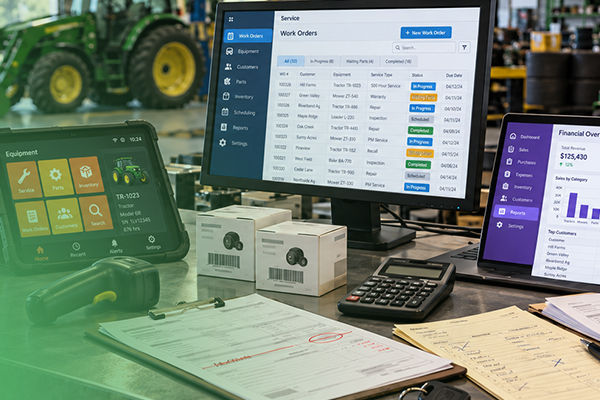
One system doesn't make people work harder. It makes the same record travel. The work order opened at the service desk is the one the parts counter pulls from, the one accounting bills, and the one your warranty claim comes from. That's how ASPEN's dealer management system is built for equipment dealers: sales, service, parts, rental, CRM and accounting sharing the same data.
Nothing gets retyped, so nothing needs catching. Your accountant works from numbers she can trust, and you can see how the business is performing without chasing anyone for a report. It won't fix a bad process (nothing will), but it stops good people from wasting good hours.
Conclusion
Disconnected systems have a cost; you can measure it, and your own numbers are the only ones that matter. Run the five-line estimate before your next budget meeting. If the total makes you wince, that's useful information.
If you'd like help checking your math, talk with one of our dealership experts. We'll walk through the numbers with you, no pitch deck required. You can also see how equipment dealer software from ASPEN fits the way you already work.


